

Maths
At Blackheath Primary School, we believe our spiralled curriculum in maths facilitates every pupil, regardless of ability, to enjoy mathematics, appreciate the magic of maths and feel empowered to succeed. We teach for mastery, aiming for our children to be able to demonstrate fluency within the basics of maths; have a secure conceptual understanding, being able to explain why maths works; and to become skilful and creative problem solvers in the wider world.Maths is taught on a daily basis throughout school. Across all year groups, we use a range of concrete manipulatives, models and representations alongside abstract concepts to support learning and help create a visual image to aid understanding. We encourage children to become independent in their approaches to Maths; to lead their own learning and apply investigative approaches; and place an emphasis on their reasoning behind their answers.
Our bespoke curriculum is based on the National Curriculum objectives, Development Matters, White Rose Maths, Mastering Number and NCETM PD Materials.
In line with the National Curriculum for Mathematics, our intent is that all pupils develop three key types of fluency: factual, procedural and conceptual.
-
Factual Fluency
Children develop automaticity in key number facts through regular, structured practice. Through approaches such as Mastering Number and Number Sense, pupils build secure recall of additive and multiplicative facts, enabling them to access more complex mathematics with confidence and efficiency. -
Procedural Fluency
Children learn and apply mathematical methods accurately and efficiently. They are supported to select appropriate strategies and procedures, developing flexibility and independence when working mathematically. -
Conceptual Fluency
Children develop a deep understanding of mathematical concepts and the relationships between them. Through reasoning, discussion, and carefully designed tasks, pupils explain their thinking, make connections, and apply their understanding to a range of contexts.Across all lessons, fluency is developed through a balance of practice, discussion, and problem solving. Teaching includes mixed-ability pairings, structured talk, and the use of anchor tasks, enabling pupils to move fluidly between fluency, reasoning, and problem solving in an interconnected way.
Our Maths curriculum supports pupils to:
- Have rich and enjoyable experiences in maths – all children are able to feel a sense of achievement and are nurtured and coached to flourish in maths
- Develop confident and positive attitudes towards maths
- Build on prior learning
- Make links and connections within maths
- Work independently and collaboratively
- Explain and reason understanding thoroughly using accurate mathematical terminology
- Use and apply mathematical understanding to real-life contexts
- Develop a growth mindset in maths
- Have a secure knowledge of core content before developing breadth and depth in learning
- Master number and develop strong number sense
Our Curriculum
We have developed a bespoke curriculum, suited specifically to the needs of our learners at Blackheath Primary School, using elements from White Rose Maths and NCETM. We follow a spiral curriculum, which allows aspects of maths to be revisited and built upon in greater depth throughout the year – aiming for mastery.
The Forgetting Curve
‘The Forgetting Curve,’ first described by Hermann Ebbinghaus in 1885, describes a decrease in the brain’s ability to retain memory over time. Within this, he champions the idea of over learning: revisiting topics at regular intervals to secure them in memory. It is the aim that by exposing children to a spiral curriculum, that knowledge will be secured and rehearsed more effectively sustaining active learning in maths, and building confidence of learners. Children will be able to develop a deep understanding of maths, rather than being able to memorise key procedures or resort to rote learning, allowing them to achieve mastery.
All lessons follow this structure:
Mastering Number and Number Sense Times Tables
From Reception - Year 3, children complete a daily session of ‘Mastering Number’ which enables children to develop Number Sense: the ability to understand, relate and connect numbers. Children with strong number sense think flexibly and fluently about numbers, allowing them to be able to visualise and talk comfortably about numbers. In lower KS2, we teach the Times Table Fluency program from Number Sense. This is a daily, discrete session which teaches children automaticity within 36 essential multiplicative facts. Fluency with these facts reduces cognitive demand enabling children to become more successful mathematicians.
Main Lesson
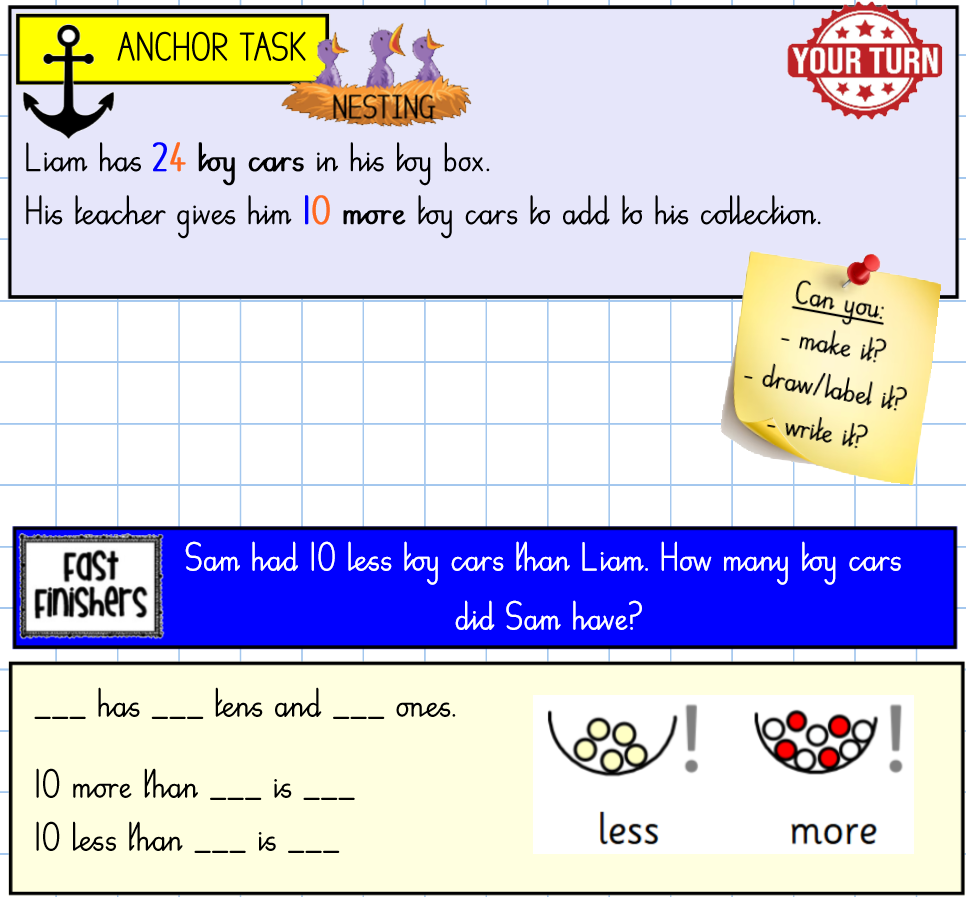
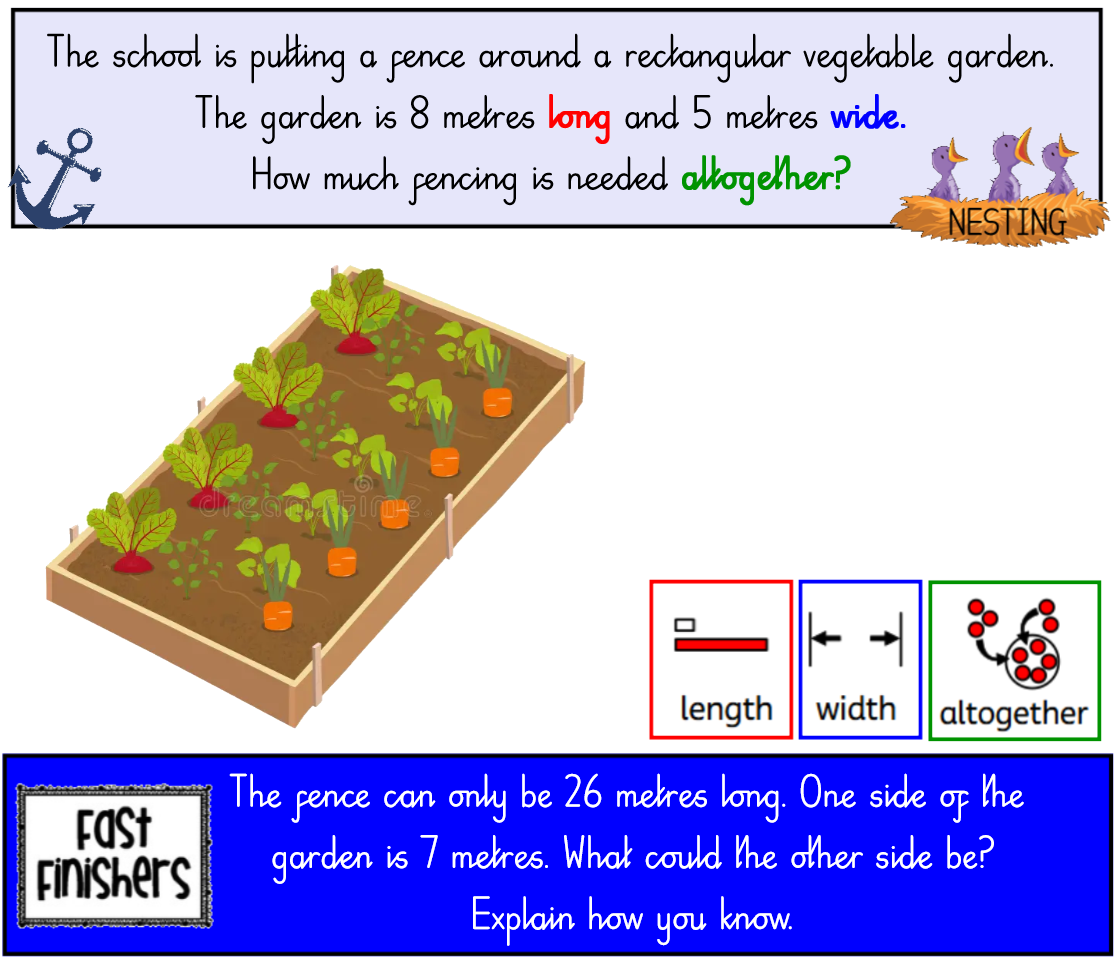
Maths lessons begin with an anchor task set in a real-life context, encouraging children to unpick a reasoning or problem-solving question through mixed-ability paired discussion. Following this, the main learning intention (WALT) and key vocabulary are introduced. All children are taught the same age-related content, with adaptations made where necessary to ensure the learning is accessible to all. Mixed-ability pairings promote collaboration and peer learning, with reasoning and problem solving in real-life contexts forming the basis of each lesson and woven throughout. Common misconceptions are identified and addressed through the main teaching, supporting children to develop secure and confident mathematical understanding.
| Anchor Task Example - KS1: | Anchor Task Example - KS2: |
 |
 |
'I do, We do, You do'
When appropriate, we utilise this approach to firstly model to children before allowing them to explore in group and partner scenarios, before working independently. This allows children to rehearse new content in a comfortable and safe environment before working independently. However, children are also given opportunity to work backwards with this approach: they begin by exploring the concept independently to allow them to decode and ‘show what they know’ before this knowledge is deepened with input from the teacher.
Fluency, Application and Reasoning
In Maths, children engage with a balance of fluency, application and reasoning within every lesson.
Children begin by developing fluency, where they practise and secure key skills and number facts, building accuracy and automaticity.
They then apply this understanding through application (consolidation) tasks, which present the mathematics in different contexts (e.g. missing number problems or varied representations), encouraging flexibility and deeper thinking.
Reasoning and problem solving is integral throughout all learning. Children are regularly asked to explain, justify and prove their thinking through prompts such as “Always, sometimes, never”, “Convince me” and “Prove it”. These opportunities are not reserved for a small group of pupils; instead, tasks are carefully adapted and scaffolded so that all children can access reasoning and problem solving at an appropriate level.
Teaching is designed to be inclusive, with mixed-ability pairings, structured talk and carefully chosen tasks enabling all pupils to move between fluency, application and reasoning, deepening their understanding and ensuring appropriate challenge for every learner.
EYFS
The EYFS framework states that developing a strong grounding in number is essential so that all children develop the necessary building blocks to excel mathematically. Children should be able to count confidently; develop a deep understanding of the numbers to 10; understand the relationships between numbers to 10; and identify patterns within those numbers. By providing frequent and varied opportunities to build and apply this understanding – such as using manipulatives, including small pebbles and tens frames for organising counting – children will develop a secure base of knowledge and vocabulary from which the mastery of mathematics is built.
In addition, it is important that the curriculum includes rich opportunities for children to develop their spatial reasoning skills across all areas of mathematics, including shape, space and measures. It is important that children develop positive attitudes and interests in mathematics, look for patterns and relationships, spot connections, ‘have a go’, talk to adults and peers about what they notice, whilst not being afraid to make mistakes.
Children in EYFS follow the 'Mastering Number' program for all Number based objectives, and supplement this with White Rose Maths for Shape, Space and Measure. Both of these programs are developed on in lower KS1 enabling a seamless transition between key stages. In EYFS, we also learn 'Number Fun' songs to help to support our learning and develop automaticity.
Characteristics of Effective Teaching and Learning
Teachers ensure that they reflect the varied ways that young pupils learn in their curriculum delivery. These ‘characteristics of effective teaching and learning’ are:
- Playing and exploring – children investigate and experience things, and ‘have a go’;
- Active learning – children concentrate and keep on trying if they encounter difficulties, and enjoy achievements;
- Creating and thinking critically – children have and develop their own ideas, make links between ideas, and develop strategies for doing things.
Early Learning Goals for Maths
Within the EYFS Framework, the ‘specific area’ of mathematics has two ELGs:
- Number: Have a deep understanding of number to 10, including the composition of each number. Subitise (recognise quantities without counting) up to 5. Automatically recall (without reference to rhymes, counting or other aids) number bonds up to 5 (including subtraction facts) and some number bonds to 10, including double facts.
- Numerical Patterns: Verbally count beyond 20, recognising the pattern of the counting system. Compare quantities up to 10 in different contexts, recognising when one quantity is greater than, less than or the same as the other quantity. Explore and represent patterns within numbers up to 10, including evens and odds, double facts and how quantities can be distributed equally.
Year 1
Children begin the new academic year with a provision-focused approach. After a whole-class Maths input, targeted groups of children work with the teacher to deepen their learning, while the remaining children engage with structured continuous provision activities. These activities are carefully designed to consolidate skills, promote independence, encourage exploration and allow children to apply their learning in hands-on, meaningful ways. Children continue with this approach until the Spring term, when they gradually transition to a more formal method of learning. Much of the curriculum is based on White Rose Maths and enriched with NCETM activities. Children also participate in the Mastering Number programme daily.
Years 2 – 6
Children are taught using a spiral curriculum, core mathematical concepts are systematically revisited throughout the year to ensure learning is embedded. The teachers plan using White Rose Maths and NCETM.
Children experience same day interventions whenever possible to ensure any misconceptions are swiftly addressed, so that the child is ready for the next lesson. We also use pre-teaching as intervention for some groups of children, alongside ‘Number Stacks’.
Multiplication Facts / Timetables
Recalling multiplication facts with accuracy is essential, especially as children progress through school, to support efficient calculations. Children in Year 4 must also complete the statutory MTC (Multiplication Tables Check), answering 25 questions within 6 seconds each.
At Blackheath Primary, we use a variety of approaches to develop times table fluency. From Year 2, children take part in rolling numbers each morning alongside quick-fire fact recall to build speed and confidence. In Years 3 and 4, we teach times tables through the Number Sense Times Table Fluency programme, ensuring structured progression and strong conceptual understanding. We also use Times Tables Rock Stars, a fun and interactive platform where children can play games independently or with peers. Weekly rewards and heatmaps are sent home so parents can track their child’s progress.

Century Tech Learning
Children in Years 3-6 also have access to Century Learning, which is an interactive platform accessible from home. This intelligent system, built using AI (Artificial Intelligence) creates a personalised learning programme for each child based on their current gaps. Furthermore, it analyses results, so parents can see strengths and areas for development within the parent dashboard to support children at home.
Useful Links
TTRS Century Super Movers Times Tables Practice Numberock MTC Tester
Key Documents