

Writing
At Blackheath Primary School, our writing curriculum aligns with our core values — Responsibility, Empathy, Smart, Politeness, Empower, Care and Team — and reflects our belief that every child deserves the opportunity to develop into a confident, articulate and imaginative writer. These values underpin how we teach and how pupils learn, ensuring that our english curriculum enables our pupils to communicate independently, think critically, and express themselves with clarity and creativity.
The National Curriculum requires children to write frequently, independently and purposefully across all subjects. Our writing lessons enable our children to develop the necessary skills to communicate effectively in writing and to transfer and apply those skills in other subjects.
In English, there are three main focus areas:
Speaking and Listening (Oracy)
Reading
Writing (including Spelling & Handwriting)
In EYFS, our children have many opportunities to develop and apply their writing. The development of language, reading and physical development play an integral role in a child’s writing journey. In line with the Strong Foundations in the First Few Years at School guidance, we prioritise high-quality interactions, a language-rich environment and systematic teaching that enables every child to succeed from the very start of their school journey.
In EYFS and Year 1, writing development is built through the Talk for Writing approach. This ensures that children first internalise language through listening, storytelling, role play and structured talk, as we recognise that oral language and storytelling underpins early writing success. Through imitation, innovation and invention, pupils develop vocabulary, sentence structure and narrative understanding alongside early transcription skills such as phonics, handwriting and spelling. Play-based and purposeful writing opportunities allow children to apply their learning meaningfully, supporting the transition from spoken to written words.
Across Years 2 to 6, we build on these early foundations in writing through the Pathways to Write scheme, which provides a clear, progressive and mastery-based approach to writing across a wide range of high-quality texts and genres. Teaching explicitly develops pupils’ understanding of audience, purpose and text structure, while systematically building vocabulary, grammar and compositional skills. Consistent modelling, shared writing and scaffolded practice ensure that all pupils, including those who need additional support, are able to succeed.
We make full use of the National Curriculum Programmes of Study for English (2014) to aid our teaching in this area. We follow this framework in all classes in Key Stage 1 and Key Stage 2
'Talk for Writing' by Pie Corbett - EYFS to Year 1
In line with the Strong Foundations in the First Few Years at School guidance, we prioritise the development of oracy, language comprehension, vocabulary and transcriptional skills as the building blocks for successful writing. We recognise that children must be able to say it before they can write it. Therefore, rich talk, high-quality interactions and purposeful play underpin our approach in the Early Years and Year 1.
Pupils are immersed in a language-rich environment where adults model ambitious vocabulary, well-structured sentences and standard English. Through stories, rhymes, songs, role play and discussion, children develop a secure grasp of spoken language, narrative structure and meaning, which directly supports early composition.
Talk for Writing as a Core approach
Early Years and Year 1 use the Talk for Writing approach as the foundation of writing teaching and learning. This enables children to internalise language patterns and text structures through:
-
Imitation: learning texts orally through actions, story maps and repetition
-
Innovation: adapting known texts to create new meanings
-
Invention: applying learned structures and language independently
This approach ensures that children build confidence, fluency and enjoyment in writing, while gradually transitioning from oral rehearsal to written composition.
We explicitly teach correct pencil grip, posture and holding the paper correctly, recognising that these physical foundations are essential for fluent and comfortable writing. Alongside these, we prioritise accurate letter formation and the correct use of capital letters and full stops, ensuring that children develop legible, correctly punctuated written work from the earliest stages. These skills are embedded through structured teaching, daily practice and positive reinforcement.
Below, Pie Corbett the founder of Talk4Writing gives a brief overview of how any why it works.
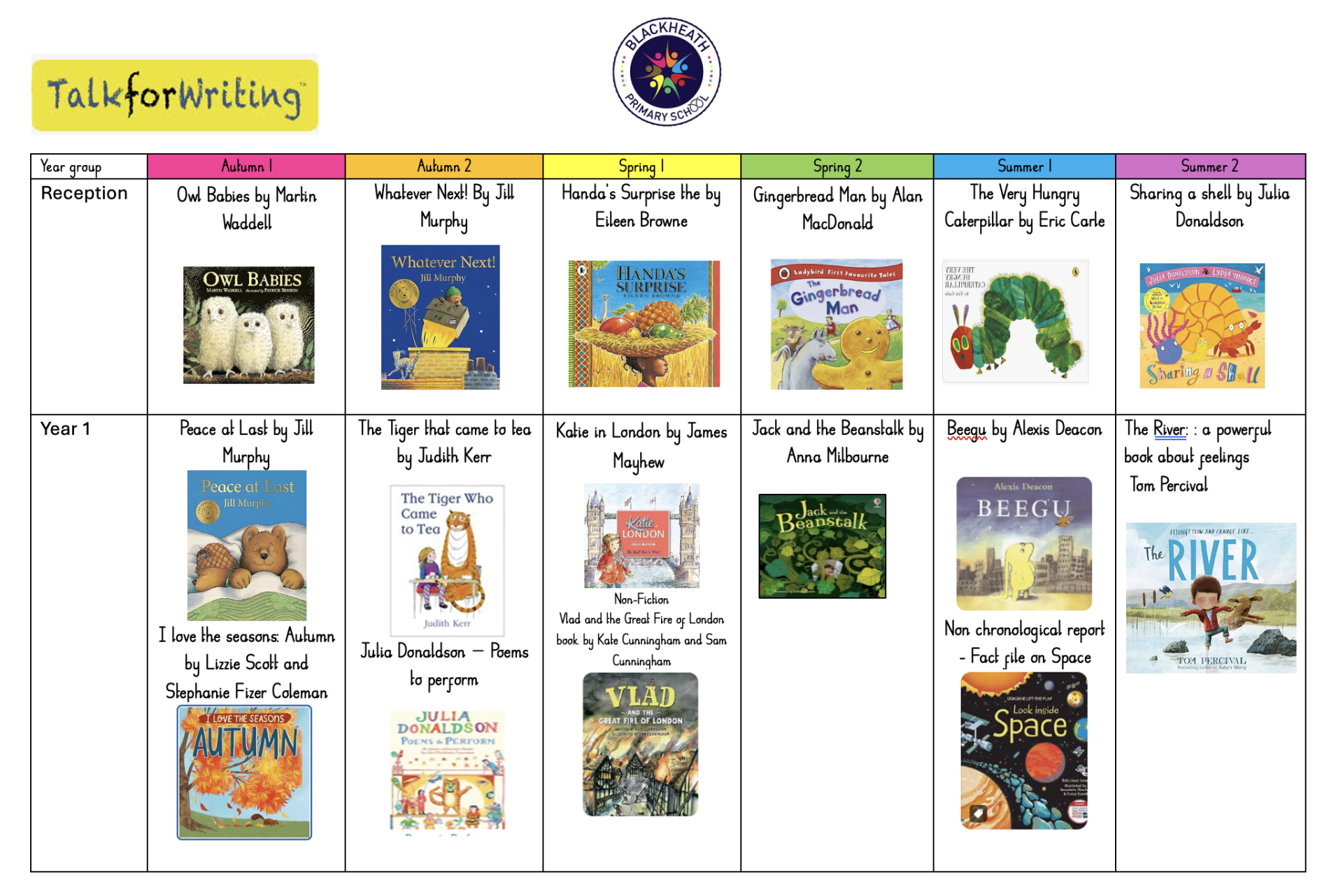
We believe that high-quality texts are the foundation for developing confident readers, enthusiastic writers, and effective communicators.In the early stages of learning, our children are introduced to carefully chosen, language-rich stories, rhymes, and non-fiction texts that support the development of oracy, vocabulary, and comprehension. Our book choices reflect children’s interests, introduce them to a diverse range of cultures and experiences, and promote a love of reading from the very beginning. Here are the texts that our children will learn across Reception and Year One.
Pathways To Write - Years 2 to 6

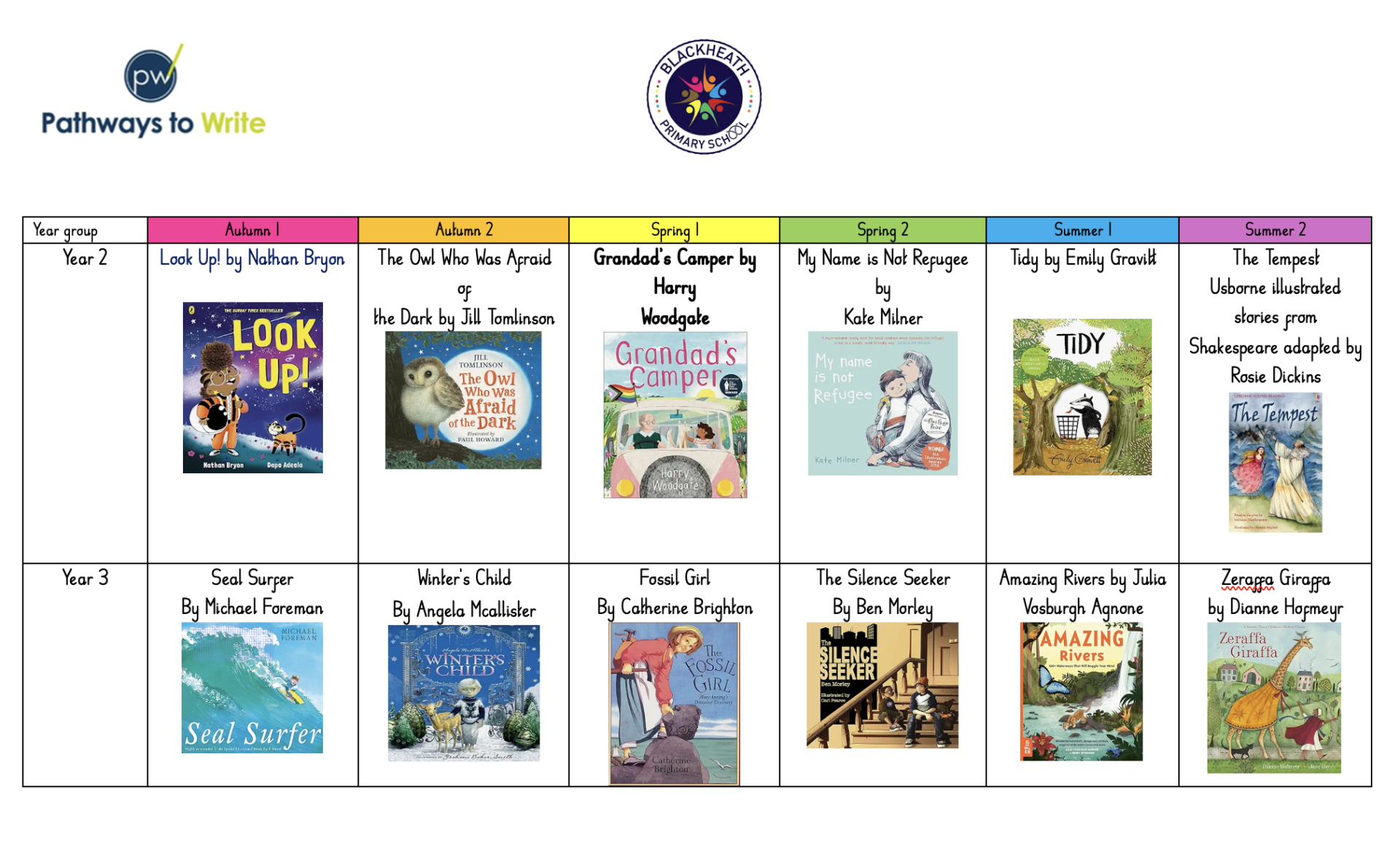
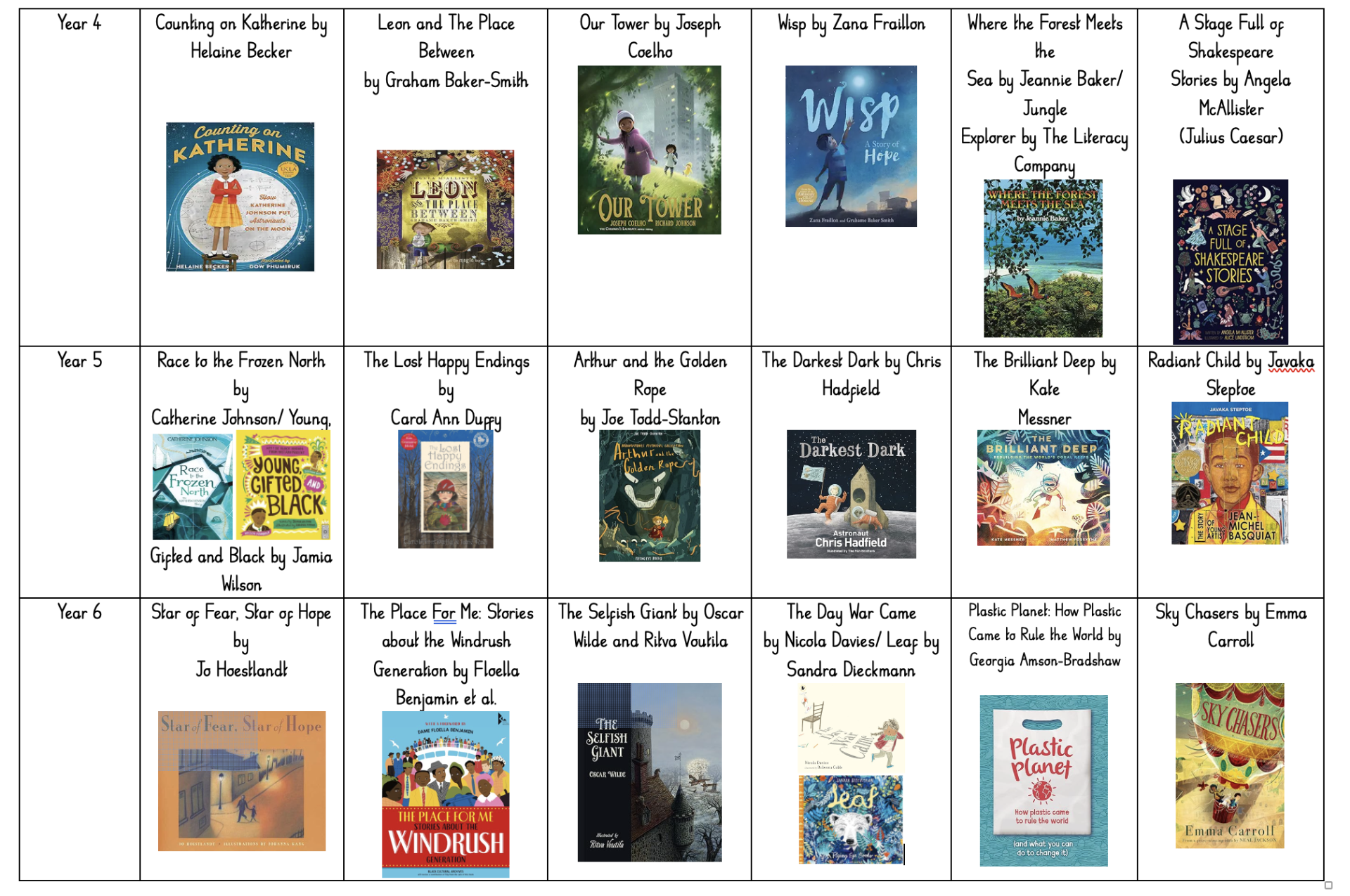
From Years 2 to 6, writing is taught through the Pathways to Write programme, ensuring a structured and progressive curriculum that builds skills, knowledge and confidence over time.
Our writing curriculum is designed using a text-based approach to help pupils acquire the necessary knowledge of grammatical structures and text types in an engaging and accessible way. This also helps to provide pupils with the desire to write and apply their knowledge and skills. The texts are carefully selected on the basis of their literary merit and to ensure an appropriate level of challenge. They also relate to our school values and the wider curriculum for each year group.
We aim to develop pupils into confident, positive and enthusiastic writers, with the intention that they will be able to write independently with resilience. It is our ambition that pupils will be able to edit and evaluate their own writing to make it the best work it can be, applying a wide range of sophisticated vocabulary, spelling and grammar skills to do this effectively. It is important that our pupils develop an awareness of the audience, purpose and context, which will prepare them for their future.
Our writing curriculum supports our commitment to Responsibility (taking pride in clear and Smart presentation), Care (thinking about audience and meaning), and Empathy (understanding context and character). Assessment for learning and targeted feedback strengthen pupil outcomes and build resilience and independence as confident communicators.
In every classroom, pupils are able to use the working walls as visual aids to support their learning. These are there to aid learning by providing models, vocabulary, examples or reminders. Although they will be neat and well-presented, they are not displays and the focus is on providing support for current learning rather than displaying pupils’ work.
Click here to download an overview of the progressive skills content for each year group in Year 2 and KS2:
Assessment of Writing
Writing is teacher assessed, and independent evidence is collected regularly for every pupil. Stage targets are ticked off after every piece of writing, to keep track of progress, find gaps to target and move pupils forward. Termly cross-school moderation of writing takes place in staff meetings. Additional support for moderating pupils’ writing takes place during phase meetings.
Spelling
Spelling sessions are taught daily in Year 1 and 2 through phonics sessions using our Little Wandle Phonics programme. In KS2, spelling sessions are taught 3 x weekly. As a natural progression from phonics, The No Nonsense Spelling Programme is used in Years Three to Six and is a comprehensive yet accessible progression in the teaching of spelling. Guidance, rather than prescription, is provided on how to teach the strategies, knowledge and skills pupils need to learn. The focus of the programme is on the teaching of spelling, which embraces knowledge of spelling conventions – patterns and rules; but, integral to the teaching is the opportunity to promote the learning of spellings, including statutory words, common exceptions and personal spellings. Exploration of spellings and word play are recorded in spelling journals. Learning in spelling is carried out using the following sequence: Learn – Practise – Apply – Assess.
Spelling - Home Learning and Assessments
Children from years one to six are tested weekly on their phonics, spelling rule or words from their common exception/non-negotiable spelling list. For home learning, children are provided with the spellings for the week and put into a sentence so that the word is in context , which will be taught and explored in class. The knowledge of this rule will then be tested the following week.
Grammar
Since 2016 children have been expected to work to much higher standards when it comes to grammar and punctuation, and they are introduced to fairly complicated grammatical concepts earlier in their primary-school learning journey.
- Sub-ordinating and co-ordinating sentences are used in Year 2 (previously they were introduced in Year 4).
- Modal verbs, subject and object and the subjunctive are given much more emphasis in the second half of KS2.
- Terminology has been updated to be in line with traditional grammatical vocabulary (connectives are now differentiated as conjunctions, prepositions and adverbs; progressive verb tenses are now known as continuous, complex sentences are referred to as multi-clauses sentences and definite and indefinite articles are looked at as determiners).
Handwriting / Presentation
Kinetic Letters for Handwriting’ is used in school from Foundation to Year 6 to teach pupils how to form letters correctly and then move onto learning joined script. Kinetic Letters is a scheme that allows children to learn letter formation through movement. Letters are formed with a distinctive flick on the end, preparing them for joining. The letters are taught through moving their bodies and saying the language as they move and then finally writing using the language.
Speaking and Listening
All staff model Standard English in the classroom. Staff promote and build in opportunities for active speaking and listening in the classroom and English curriculum. Speaking and listening form the foundations of literacy development and plays an essential role in enabling children to become effective writers.
The strands of speaking and listening are as follows:
- Talking to others - Talk in purposeful and imaginative ways to explore ideas and feelings, adapting and
varying structure and vocabulary according to purpose, listeners and content
- Talking with others- Listen and respond to others, including in pairs and groups, shaping meanings
through suggestions, comments and questions
- Talking within role-play and drama- Create and sustain different roles and scenarios, adapting
techniques in a range of dramatic activities to explore texts, ideas and issues
- Talking about talk- Understand the range and uses of spoken language, commenting on meaning and
impact and draw on this when talking to others
Children have the opportunity to develop their speaking and listening skills through a range of strategies and a rich speaking and listening environment.
Key Documents
Useful Links